


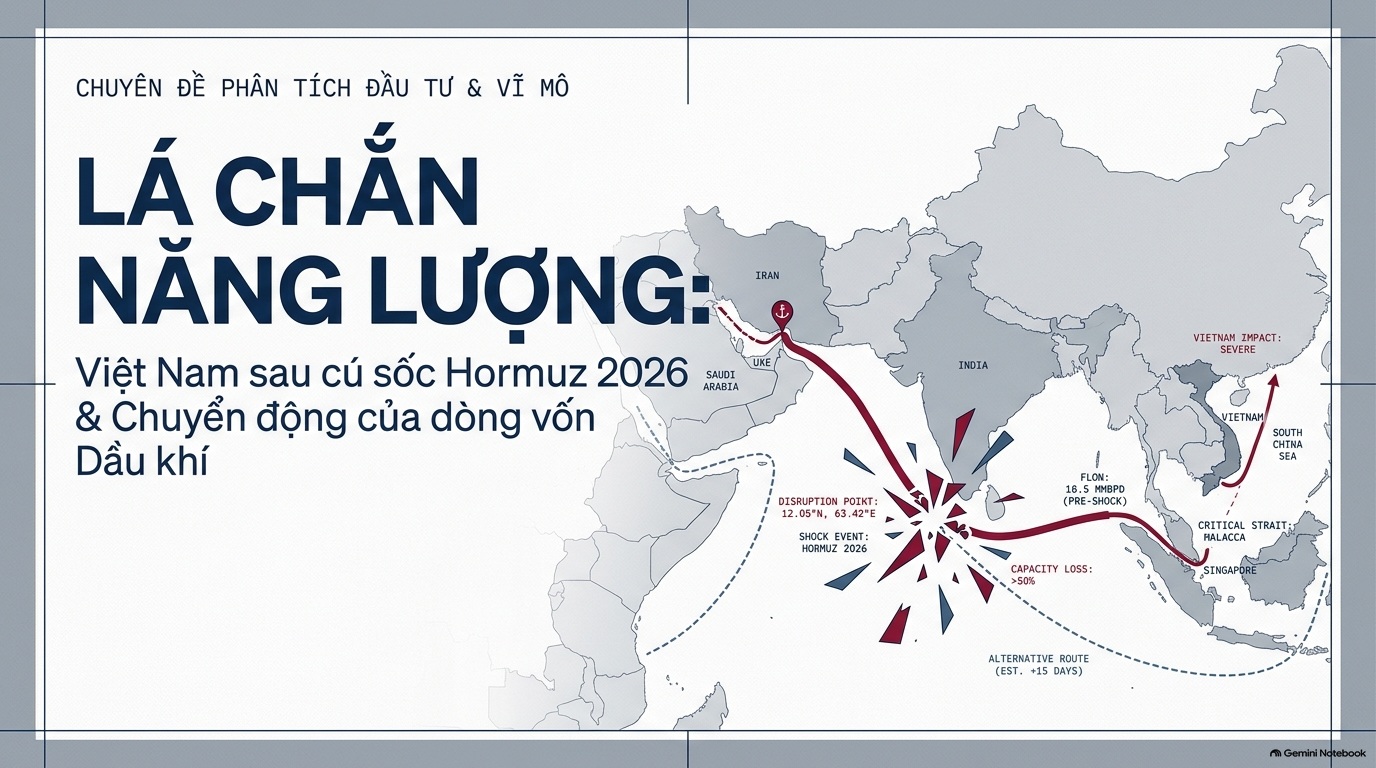
Vietnam has oil fields, has refineries, and even has a national energy corporation — yet when a strait thousands of kilometers away is blockaded, the Nghi Son Refinery’s fuel reserves last only until the end of March. This is the paradox exposed by the 2026 Hormuz crisis: domestic oil production does not equate to energy independence, when 87% of crude oil imported to operate Nghi Son comes from Kuwait, while LNG depends on Qatar and UAE — the exact epicenter of the conflict.
After February 28, 2026, when the US-Israel strikes on Iran were met with Iran’s blockade of the strait, Vietnam’s energy security story ceased to be an academic issue. It forced the entire policy apparatus into motion — and this is precisely what deserves attention from investors: these shifts have not stopped at declarations, but have entered into law, into investment capital, and into the quarterly earnings of listed companies.
State strategy: from resolution to concrete action
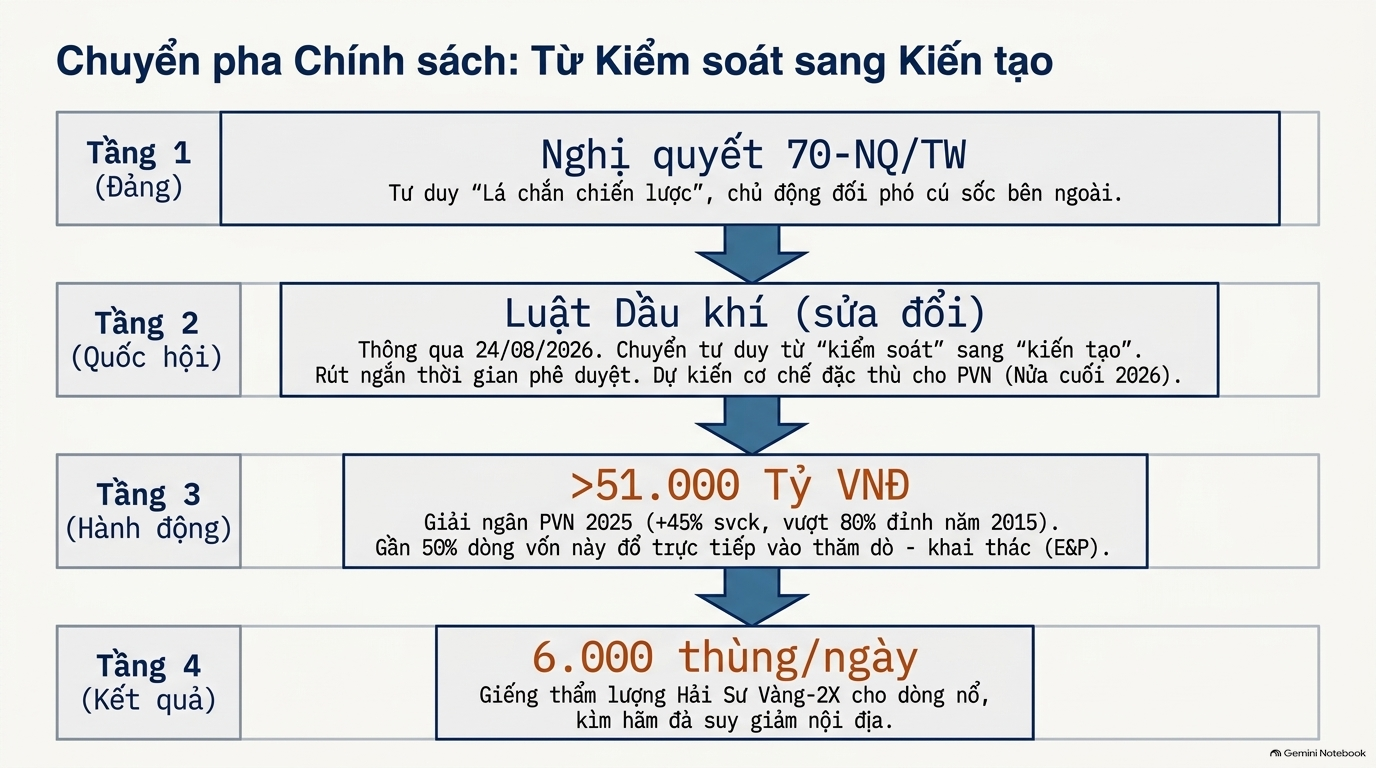
The Politburo issued Resolution 70-NQ/TW, regarded by experts as a strategic “shield” to help Vietnam become more proactive against external energy shocks. On that foundation, the 16th National Assembly formally passed the amended Petroleum Law on August 24, 2026, shifting the management mindset from “control” to “fostering development” — the goal is to shorten the timeline from discovery to exploitation, accelerating the conversion of investment capital into actual output. Notably, the Assembly plans to continue considering a special mechanism tailored specifically for the Vietnam National Industrial Energy Group (the new name for PVN, reflecting its expanded role in economic and maritime security) in the latter half of 2026.
This is not change on paper. PVN’s investment disbursement in 2025 exceeded VND 51 trillion, up 45% year-over-year and up 80% compared to the 2015 peak — a record level, with nearly half directed to exploration and production. The results are taking shape: the Hai Su Vang-2X appraisal well in block 15-2/17 (Cuu Long Basin) delivered flow rates around 6,000 barrels per day, with estimated reserves of hundreds of millions of barrels of oil equivalent — a rare signal helping to slow the long-standing decline in domestic crude output.
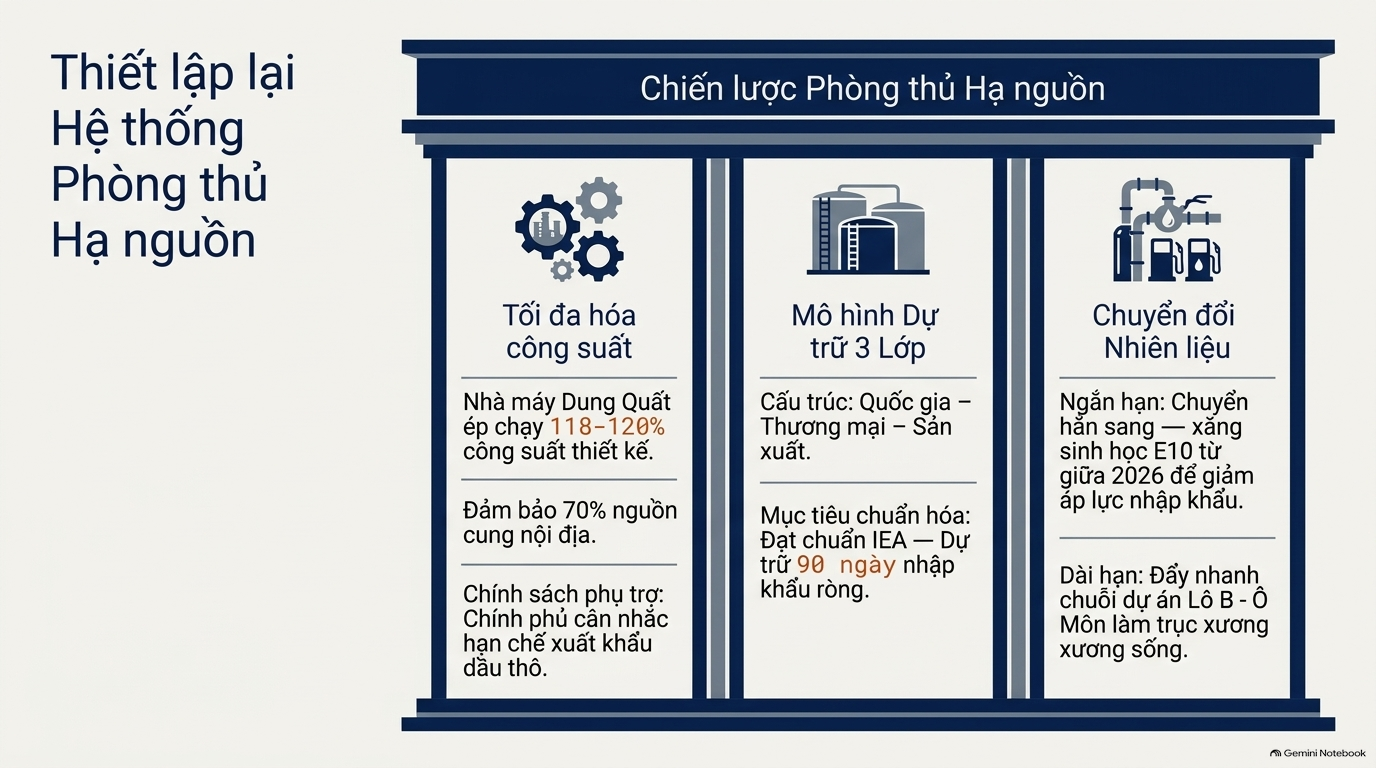
On the downstream side, Dung Quat Refinery has been tasked to operate at 118-120% of design capacity to self-supply roughly 70% of domestic demand, while the Government is considering restricting crude exports to prioritize domestic needs. In parallel is the strategic reserves equation — Vietnam is recalibrating its three-tier reserve model (national, commercial, production) toward the IEA benchmark of 90 days of net imports, alongside a roadmap to transition fully to E10 biofuel from mid-year. And for the long term, the Lot B – O Mon field (gas, pipelines, four power plants) continues to be identified as the backbone of national energy security over the coming decade.
Key figures: Resolution 70-NQ/TW (strategy), amended Petroleum Law (Aug 24, 2026), PVN 2025 disbursement up 45% yoy, Dung Quat running at 118-120% capacity, target reserve of 90 days of net imports.
Beneficiary stock groups: who is truly “capturing” this story?
PVS — contractor for the self-sufficiency strategy
PVS is most directly tied to the new investment flow in the sector, securing EPC/EPCI packages for Lot B – O Mon and Lac Da Vang with estimated total contract value around USD 1.5 billion. After-tax profit in Q1 2026 rose 25% year-over-year, and the full year is forecast to grow by an additional 9%. The PVS share also responded positively right after the amended Petroleum Law was passed — reflecting expectations that the backlog will continue to thicken as project approval cycles shorten.
PVD — direct beneficiary of the new drilling wave
PVD’s after-tax profit in 2026 is forecast to surge roughly 39.7% year-over-year, driven by higher platform utilization, rising rig day rates, contributions from platforms PVD XIII and PVD IX, and PVD I reaching the end of its depreciation life. The company is also expanding well services to Malaysia through a long-term contract with Petronas, and deployed a heavy workover unit (HWU) worth USD 8 million starting June 2026. This was also the stock with the strongest reaction in the oil and gas group — up more than 4% on the day the amended Petroleum Law passed.
Notable point: the quarterly picture is not entirely smooth — PVD’s Q2 2026 after-tax profit actually fell 29-32% year-over-year despite revenue up 24.6%, due to two one-time costs related to platform upgrade and the Song Doc field closure. This exemplifies how the policy narrative (very positive) and actual operating results (lagged, noisy) do not always move in sync.
PVT — most direct and immediate beneficiary
If one stock best captures the Hormuz story, it is PVT. The company holds nearly all market share in domestic crude and LPG transportation, and simultaneously maintains a fleet operating directly in the Hormuz strait while securing full revenue from customers during the tension period. Tanker and LNG transport rates held elevated levels in the first half of 2026 as demand for alternative supply from the Americas and West Africa drove longer-distance routes — but these longer routes are precisely PVT’s incremental revenue source. Result: Q2 2026 net revenue exceeded VND 5,700 billion (+32% yoy), net profit VND 553 billion (+87% yoy) — a record level, the share jumped limit-up on the earnings announcement. The company also aims to expand its fleet to 100 ships, from the current scale of roughly 64-67 vessels.
Data transparency note: Q1 2026 after-tax profit was recorded by some sources at +48% growth (around VND 319 billion, possibly parent company shareholders’ portion) and by other sources at +40% (VND 387 billion, possibly consolidated) — the gap should be cross-checked against official financial statements before incorporating into valuation models.
GAS — infrastructure pillar but at elevated profit levels
PV GAS completed the first half of the year on track with consolidated revenue exceeding VND 82 trillion and pre-tax profit surpassing VND 11,200 billion, amid severe Middle East conflict impact on global energy markets — a testament to its role maintaining energy security. However, 2026 profit growth momentum is assessed as unlikely to break out significantly, given the high comparison base from 2025 (from reversal of cost provisions), while LNG imports remain insufficient to offset the decline in domestic natural gas output. GAS’s long-term story is closely tied to the Lot B – O Mon timeline rather than short-term operating results.
BSR — attractive valuation but sensitive to refining margins
BSR recorded Q1 2026 ahead of forecasts with net revenue VND 45,920 billion and parent company after-tax profit VND 8,265 billion. Projected 2026 EV/EBITDA valuation stands at 4.5x — roughly 34% below the 5-year median, though the share fell 41% from its March 2026 peak before recovering around 18% recently. Sustaining wide diesel-gasoline spread in the second half of the year supports the outlook, but risk lies in potential tightening of refining crack margins if crude prices soften and regional supply chains stabilize.
Headwinds and cautious perspective
The picture is not uniformly rosy. The downstream retail group (PLX, OIL) is generally viewed less positively than upstream, as profit margins are easily squeezed by rising import costs when supply chains are disrupted. Transport rates and service pricing inherently reflect an uncertain geopolitical situation — if Hormuz were to reopen and stabilize soon (a scenario that occurred short-term back in June), the “premium” portion of PVT, PVS, and PVD earnings could contract just as rapidly as it expanded. PVD itself in Q2 2026 showed how one-time costs can distort profit even though the long-term foundation (backlog, policy) remains positive.
In other words, one must separate two narrative layers: the macro policy layer (Resolution 70, amended Petroleum Law, record PVN investment) is highly favorable and structural in nature; while the quarterly operating results of individual companies depend heavily on short-term factors — global oil prices, one-time costs, year-over-year comparisons — which do not necessarily move in lockstep with policy initiatives.
The question facing investors interested in the oil and gas group now: is the earnings growth stemming from the “Hormuz effect” of PVT, PVS, PVD being priced by the market as a long-term story (thanks to energy self-sufficiency policy), or is it merely a point-in-time profit windfall that will cool alongside Middle East tensions?
This article is for information synthesis and reference analysis only, and does not constitute a buy/sell recommendation under the Securities Law 2019. Investors must conduct their own due diligence and bear responsibility for their investment decisions.